
When people hear the word memory, they often imagine a mental photo album—a tidy archive of everything we’ve seen, felt, or done. But what if I told you that memory isn’t really about the past at all?
In fact, one of the most transformative insights I’ve gained through neuroscience research is this: memory evolved not simply to help us recall the past, but to help us simulate the future.
That hypothesis became the heart of my research paper, Beyond Recall: How Memory Shapes Tomorrow. Through a deep dive into neuroscience literature, neuroimaging studies, and cognitive theory, I explored how our brains use the fragments of past experience—not as an archive to be accessed, but as raw material to build mental models of what might come next. In my paper, I explored a fascinating hypothesis in neuroscience: that memory evolved not just to help us recall the past, but to help us imagine what could happen next.
Publishing this research paper was a journey in itself. After completing the manuscript, I embarked on a five-month journey of revisions and edits to publish with The National High School Journal of Science (NHSJS), a peer-reviewed journal. I am incredibly grateful to the NHSJS team for their generous mentorship and thoughtful feedback. They challenged me to think more critically, to rewrite until the core ideas were crystal clear, and to stand behind every citation. My publication fee was also waived, which made this opportunity even more accessible. The paper is expected to be published in the July edition. (I will add the link later.)
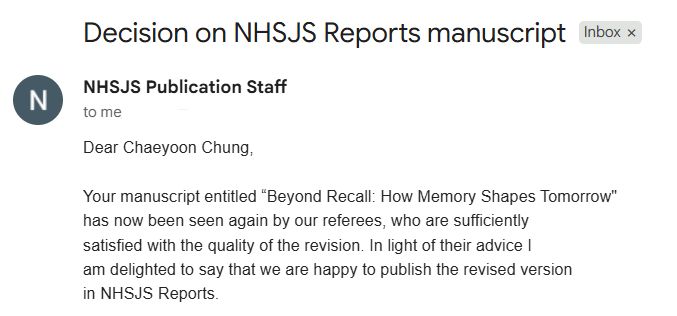


Now, I would like to share and walk you through what I published—and why it changed the way I think about my own thoughts.
Memory: Not Stored, but Scattered
First, let’s bust a myth. Memories are not stored in one place in the brain. They are distributed, meaning that pieces of each memory—like the sights, smells, emotions, and sounds—are stored across many different brain regions. When you remember something, your brain reactivates those scattered fragments and stitches them back together.
This stitching isn’t always perfect. Sometimes we mix up details or forget where a memory came from. Neuroscientists call these source memory failures or gist-based distortions. While they sound like bugs, they’re actually features of a memory system built for flexibility—not accuracy.
Memory Is Constructive: The CESH Model
This flexibility forms the basis of something called the Constructive Episodic Simulation Hypothesis, or CESH.
According to CESH, memory didn’t evolve just to replay the past. It evolved to simulate the future. When you imagine what your next birthday might look like or rehearse what you’ll say in a job interview, your brain is taking fragments of past experiences and creatively recombining them into something entirely new.
That’s right—your imagination is powered by your memory.
The Brain Behind It All
The same regions of the brain that activate when we remember something—like the hippocampus and parts of the Default Mode Network—also light up when we picture the future. fMRI and PET scans show this overlap clearly. Our brains aren’t just memory banks. They’re simulation engines.
And that leads to a beautiful realization: when we daydream, plan, or even worry, we’re not wasting time. We’re exercising one of the brain’s most advanced functions—mental time travel.
Forgetting Is an Act of Intelligence
Here’s another mind-bender: forgetting is good for you. Seriously.
The brain practices something called adaptive forgetting. It lets go of information that probably won’t help you and keeps what might. This makes your memory leaner, more efficient, and better at helping you predict the future.
Think of it like pruning a tree. You trim away the unnecessary branches so the ones that matter can grow stronger.
So… What’s the Point?
If there’s one thing I hope you take away from my research, it’s this:
Memory is not a mirror. It’s a map.
It doesn’t just reflect what happened. It helps you navigate where you’re going.
It’s messy. It’s malleable. It’s beautifully imperfect. And it’s designed that way because life is unpredictable—and memory must be flexible enough to prepare us for whatever comes next.
Studying the science of memory has transformed not just how I think about remembering, but how I understand myself. When I forget something now, I don’t beat myself up. Instead, I pause and ask myself: What is my brain making space for?
Perhaps something new. Perhaps something more important. Perhaps a future I haven’t yet imagined.
Thank you for reading!

 Teens Connect The World: Brain, Children and Love
Leave a comment