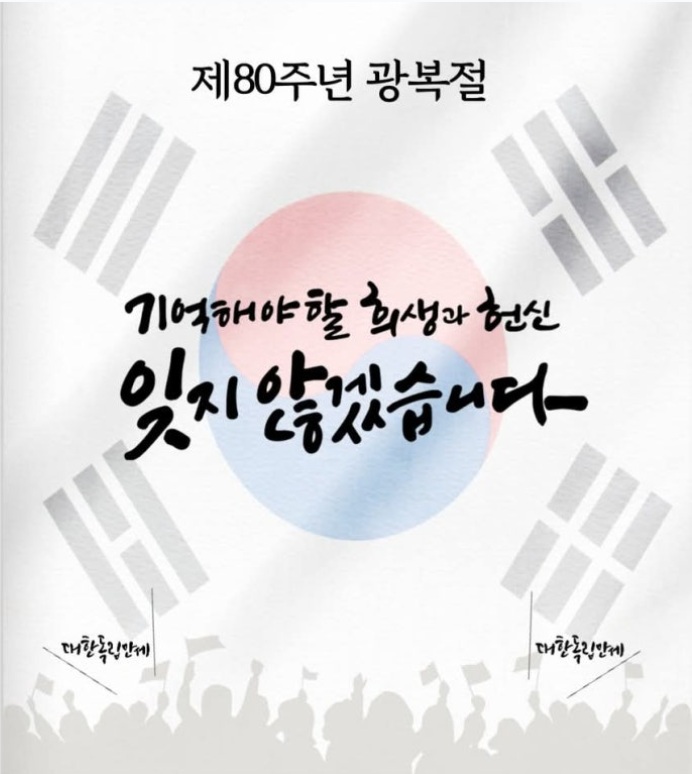
On August 15, 1945, Koreans stepped into a new dawn. After thirty-five years of Japanese colonial rule, the nation was free. That date is now remembered as Gwangbokjeol (광복절), “the day the light returned.”
This year, 2025, marked the 80th anniversary of that historic day. Eight decades later, Gwangbokjeol continues to remind us that freedom is not simply a gift of history but a legacy we must carry forward.
Liberation and Its Legacy
The Japanese occupation of Korea (1910–1945) was marked by cultural suppression and political control. Korean language and traditions were forced into silence, while independence activists risked their lives in resistance. When Japan surrendered in 1945, Koreans flooded the streets waving their long-banned flag, the Taegukgi.
The name Gwangbok captures the feeling perfectly: not just “independence,” but the return of light after decades of darkness. Still, liberation was bittersweet. Division at the 38th parallel soon followed, setting the stage for the Korean War and a peninsula still searching for peace.
The weight of Liberation
On August 15, 1945, Koreans rushed into the streets, waving the Taegukgi flag that had been banned for decades. They cried, sang, and shouted together because the light had finally returned after thirty-five years of Japanese colonial rule.
When I think of that moment, I imagine my great-grandparents among the crowds. Did they sing? Did they cry? Did they wonder if their children would finally be able to grow up without fear? Liberation was not just political. It was deeply personal. It gave people back their names, their voices, their dignity.
Yet, liberation also came with division at the 38th parallel. My family’s story, like so many others, still carries the echo of that separation. The peninsula remains divided, and the dream of full unity is still unfinished.
Making 80 Years in Korea
In Korea, the 80th anniversary was marked by ceremonies and cultural projects that carried both solemnity and celebration. At Seoul’s Sejong Center, thousands gathered as the Seoul Philharmonic Orchestra performed. Actress Song Hye-kyo and Professor Seo Kyung-deok launched a project to donate 10,000 books about independence to libraries and schools around the world, ensuring that the next generation knows that freedom has a story and that story must be remembered.
I wasn’t there in Seoul, but reading about these events made me realize something: anniversaries like this are not just about history. They’re about identity. They remind us that freedom is fragile, and that keeping it alive requires more than memory. It requires active retelling.
From Korea to the US
What touched me this year was how the anniversary resonated far beyond Korea. Across the U.S., Korean communities gathered to honor the day.
- In San Francisco, City Hall filled with nearly 1,000 people for drumming, taekwondo, and traditional dances. I thought of early Korean immigrants who, even far from home, carried the dream of independence in their hearts.
- In Los Angeles, music became the language of remembrance. Gala concerts at the Walt Disney Concert Hall honored independence leaders, while the Korean Friendship Bell rang out across San Pedro, each strike echoing resilience.
- In Norfolk, Virginia, ceremonies at the MacArthur Memorial blended history with performance, reminding everyone that freedom and memory go hand in hand.
Even activist groups took to the streets in New York, Seattle, and other cities, calling for peace and reunification on the peninsula. Liberation Day became both a celebration and a call to action.
Texas Lights Up
Closer to home, in Texas, Gwangbokjeol was alive in our own neighborhoods.
In Fort Worth, the Korean Association hosted a ceremony where elders shared their voices and families gathered to reflect on what 80 years of freedom means. It struck me that for many of them, liberation isn’t a textbook chapter. It’s a lived memory.
In Houston, at Haden Park, the Korean War Veterans Association and Korean families came together at sunset. Veterans stood alongside young children, linking generations through shared sacrifice and gratitude. Watching photos of the event later, I realized that this is what liberation looks like now: not just flags and parades, but communities building bridges across age, culture, and memory.
As a Korean living in Texas, it felt personal. Here, thousands of miles from Seoul, the light of Gwangbokjeol still shines.
Carrying the Light Forward
Eighty years later, the challenge is not only to remember but to live liberation. That means honoring elders’ stories before they are lost, building connections across generations, and keeping alive the dream of peace.
I see Gwangbokjeol not just as history, but as a mirror. It reflects how far we’ve come, and it asks us how we will carry the light forward.
For me, that means writing, remembering, and building connections even here in Texas, where the Korean flag waves at local ceremonies and where stories of freedom are retold in community centers and parks.
So I’ll end with the same question I carry with me: What does liberation mean to you?
For Koreans, it began with the return of light in 1945. For all of us, it is a reminder that freedom must be protected, cherished, and carried forward so that eighty years from now, the light still shines.

 Teens Connect The World: Brain, Children and Love
Leave a comment